Hi everyone! This is LEON from Denei.
At Denei, our mission is to personally experience traditional Japanese culture and share the authentic things we love with you. Today’s report is about a tea ceremony Kyoto visitors rarely get to see — one hosted in a private tea room by a friend of mine.
Recently, I was invited to a tea ceremony Kyoto visitors almost never get to see — a private gathering hosted by a good friend of mine. It was conducted in the style of the Yabuuchi school (藪内流) — and if you’ve only ever heard of Urasenke or Omotesenke, this one is worth knowing about.
New to Zen and tea in Kyoto? We also run Kyoto Zen Guide, an honest comparison of temples where you can experience zazen in English.
Here is a report on the day.
Why “Samurai-Style”? The 400-Year Story of the Yabuuchi School
The Yabuuchi school traces back to Yabunouchi Kenchū Jōchi (1536–1627), the last major disciple of the tea master Takeno Jōō — which made him a fellow student of the legendary Sen no Rikyū himself.
The two were close in a way that goes beyond tea. Rikyū gave Kenchū a tea room called Unkyaku. Kenchū married the younger sister of the warrior-aesthete Furuta Oribe, and Rikyū served as the matchmaker at that wedding. Oribe, for his part, gave Kenchū an entire tea house — Enan, along with its garden path and front gate. Enan was designated an Important Cultural Property of Japan in 1976, and it still stands at the Yabuuchi family home today.
And here is the detail that explains the title of this post. Around 420 years ago, when the warlord Toyotomi Hideyoshi ordered Rikyū to codify and unify the etiquette of tea ceremony, Kenchū was one of the people who helped him do it. The school has carried both traditions ever since: the tea methods inherited from Takeno Jōō, and Rikyū’s revised methods — preserved together as kogi sadō, “the old-form way of tea.”
That warrior-era lineage is still visible in the movements themselves. Practitioners of other schools often say, “Yabuuchi’s temae looks like a samurai’s” — or simply, “it’s masculine.” There are concrete reasons for that impression:
- The fukusa is worn on the right hip. In most schools the silk cloth used to purify the utensils sits on the left. In Yabuuchi it sits on the right — the side a swordsman keeps free.
- The movements are broad and unhurried. Larger gestures, more visible reach, less of the compact economy you see elsewhere.
- Both formal and rustic tea, side by side. From 1640, the second-generation head Getsushin-ken served as the official tea master of Nishi Honganji temple, and the family held that role until the Meiji era. That responsibility meant they had to maintain both the formal shoin-style tea of Rikyū’s court and the humble wabi-style tea of the small hut. Most schools specialize. Yabuuchi kept both alive.
There’s a tradition from that Honganji connection that has never broken: since 1644, on the seventh day of every January, the head of the Yabuuchi family presents tea to the chief abbot of Nishi Honganji. Fourteen generations later, they still do.
Invited by My Friend, the Future 4th-Generation Owner
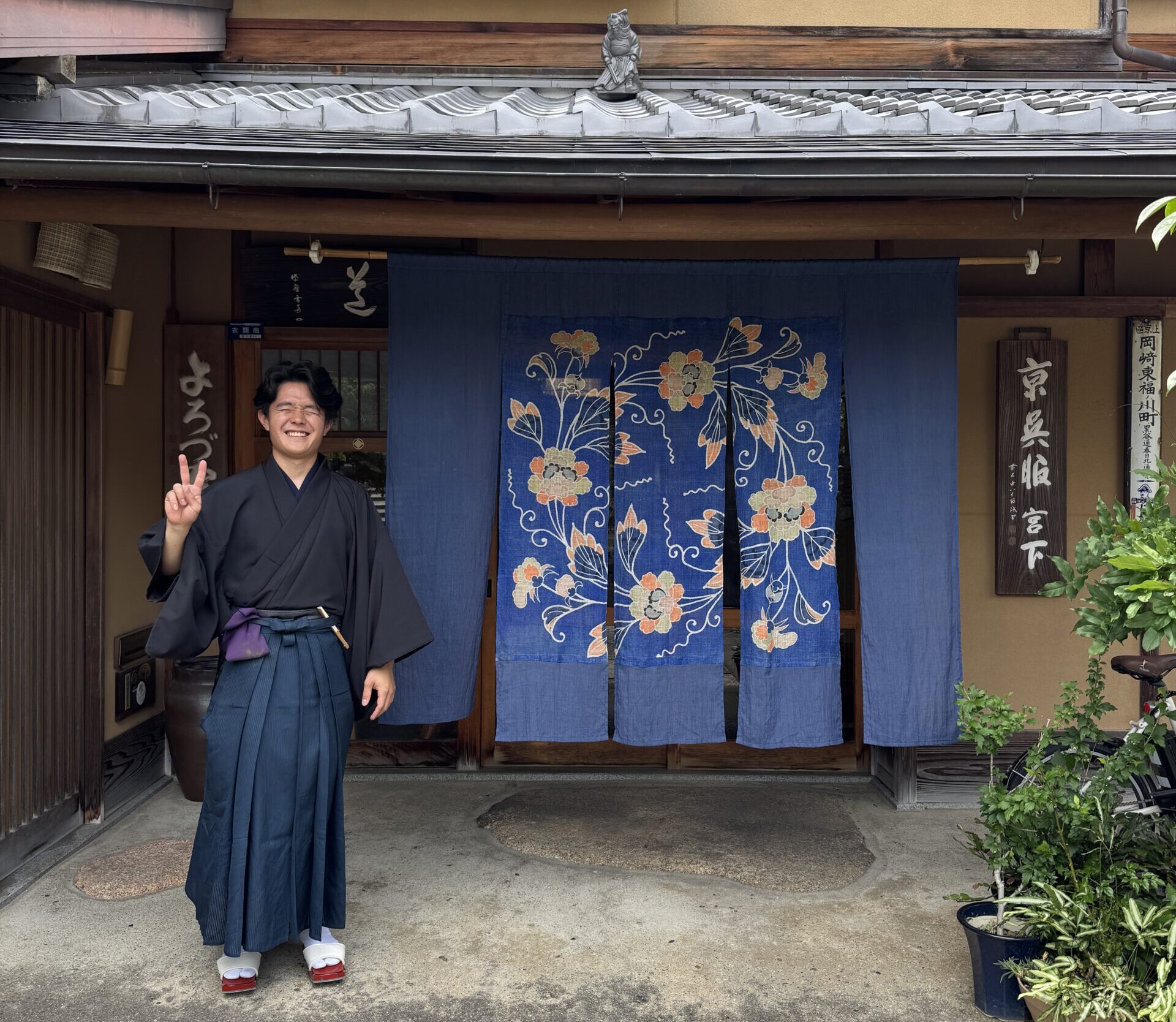
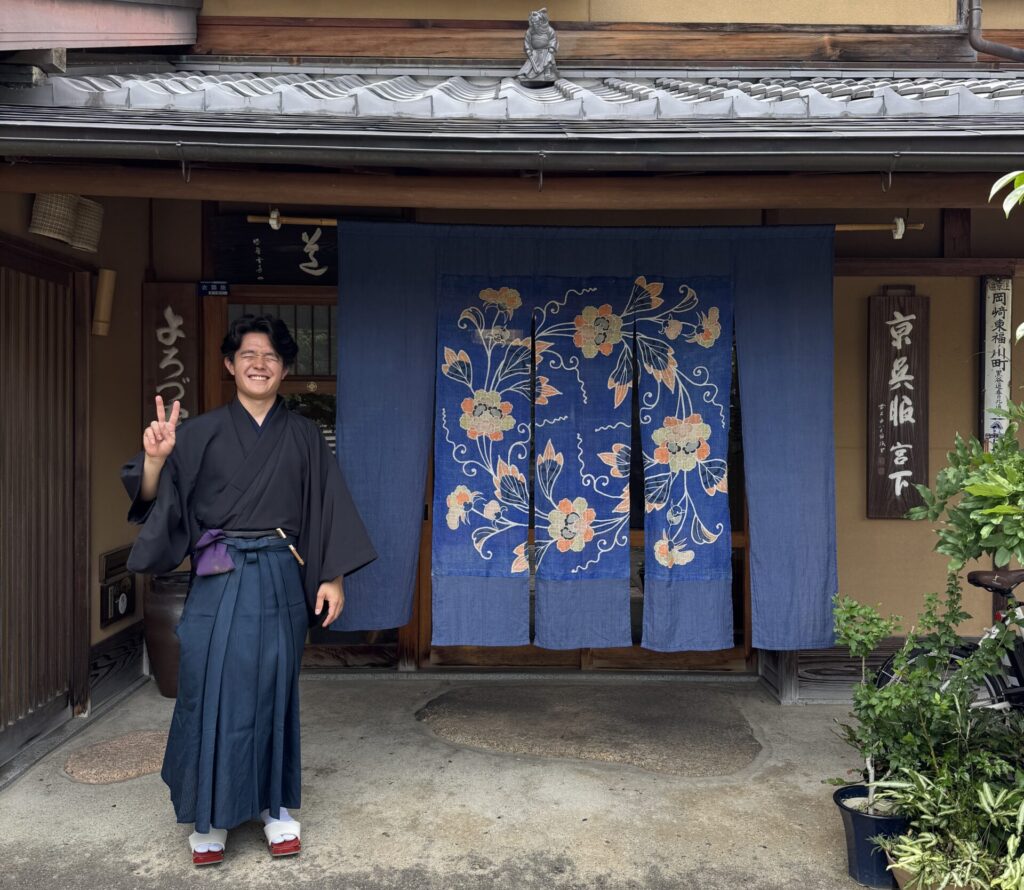
The person who invited me is my friend, Ryotaro Miyashita.
He is the next in line at Miyashita Gofukuten, a kimono house in Kyoto — and the story of how that house came to exist is worth telling.
It began with a painter. Ryotaro’s great-grandfather, Taro Miyashita, trained as a yuzen artist: the person who draws the designs directly onto kimono silk, by hand, with a fine brush. Then he came home from the Second World War and developed a retinal condition that took most of his sight. The painting career was over.
What didn’t end was the wish to put beautiful kimono into people’s hands. In 1953 he founded Miyashita Gofukuten, sketching designs on paper and carrying them door to door, proposing made-to-order kimono to customers one household at a time.
The second generation, Koichi, widened the business — new premises in 1973, and exhibitions of his father’s work at some of Japan’s most prestigious ryotei and ryokan in 1977. The shop moved to its current location in Okazaki in 2003.
Ryotaro’s father, the third-generation Takayuki, arrived at a harder question: if you only sell kimono, does the culture actually survive? His answer was to stop thinking of kimono as merchandise and start creating occasions to wear them — places where customers could meet the artisans directly and talk with them.
Ryotaro’s tea gatherings for international visitors come out of that same answer. While helping with the family business, he hosts authentic tea ceremony experiences for guests from abroad.
Previously, Ryotaro joined a zazen (Zen meditation) session that Denei organized at Myoshinji Temple. It seems he invited me to this tea gathering as a thank-you for that time. Thank you, Ryotaro!
We met up at his kimono shop at 10:30 AM, and he welcomed me with a huge smile. After a brief chat about the day’s gathering, we made our way to the tea room.
Stepping Stones and the Crawling Entrance: The Magic of a 4.5-Mat Tea Room
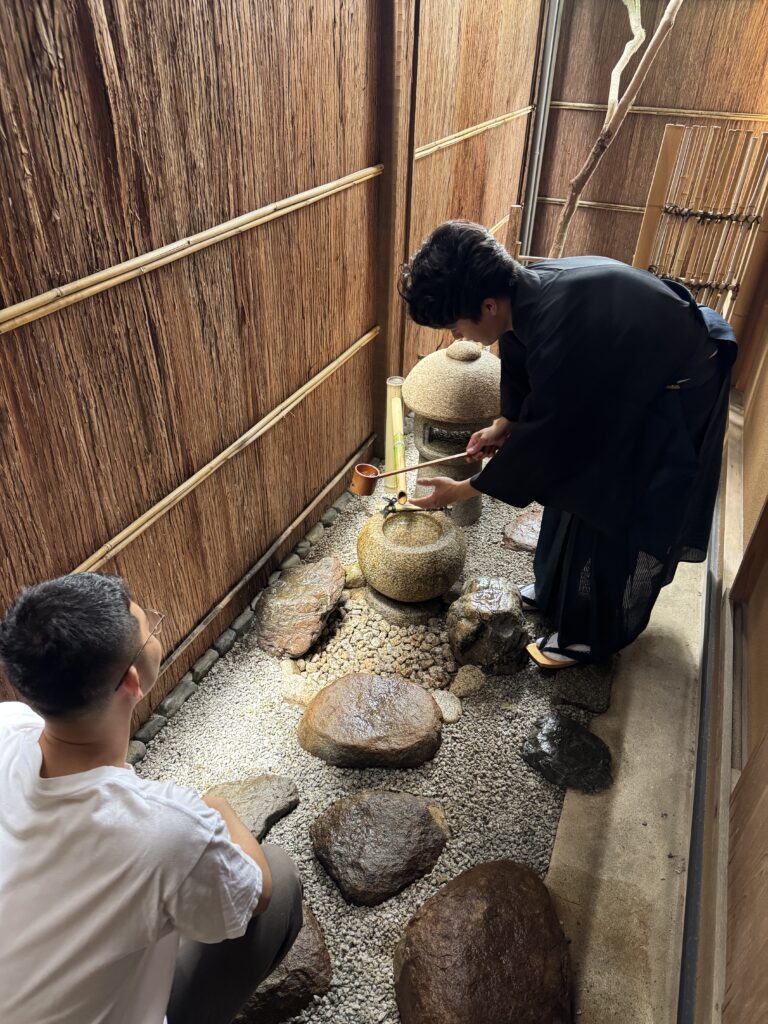
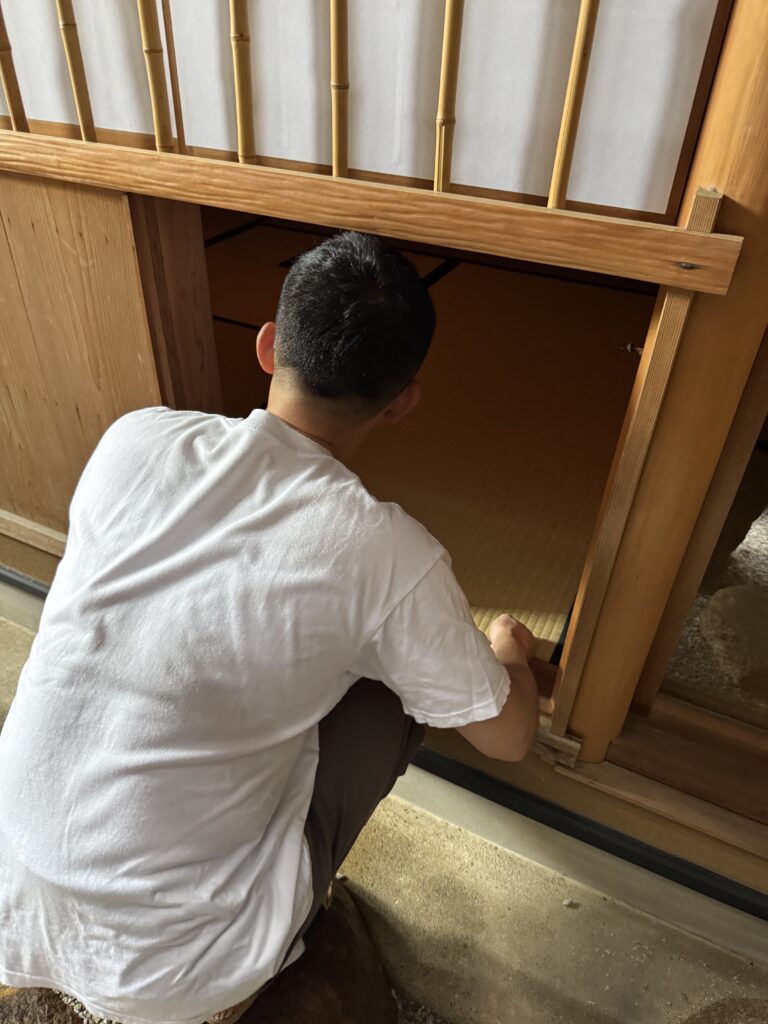
Walking through the garden, I stepped on each stepping stone and purified my hands at the tsukubai (stone washbasin). I then crouched down to pass through the nijiriguchi — a small crawling entrance — to enter the 4.5-tatami mat tea room.
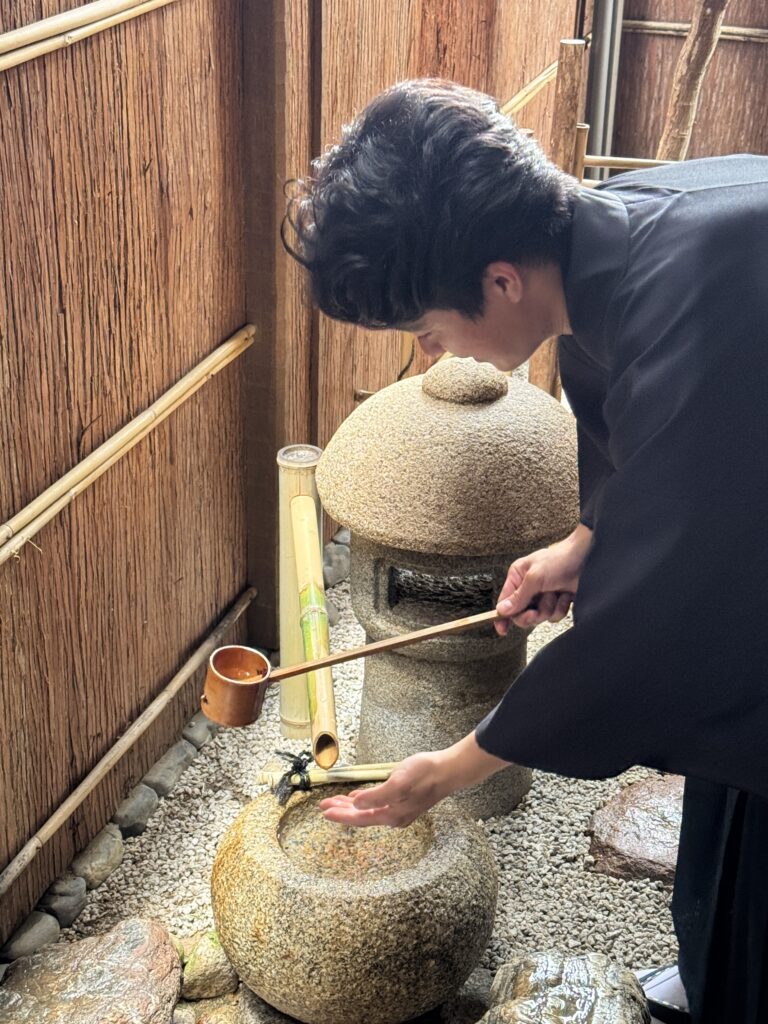


A tea ceremony Kyoto visitors experience usually happens in a room like this one. If you have never been inside one, it is hard to explain how much the architecture is doing. Three things in particular:
- The crawling entrance strips away rank. The nijiriguchi is roughly 70cm square. Everyone — the host, the guest, a lord, a merchant — has to bend and go in low. You cannot enter a tea room while standing on your status.
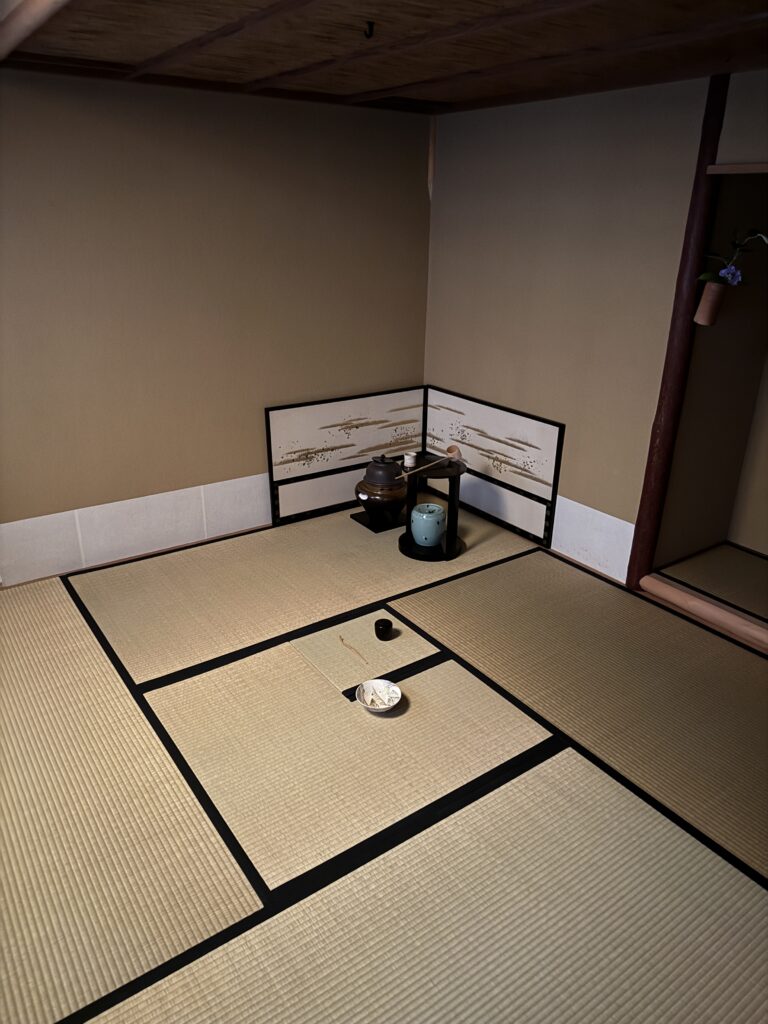
- 4.5 mats is deliberately, almost uncomfortably small. About 2.7 meters square. Close enough that you hear the water. Close enough that you cannot politely ignore anyone.
- The light is kept low on purpose. In this room it was dim — just bright enough that I could barely perceive the green of the matcha. It pulls your eyes in instead of letting them wander.
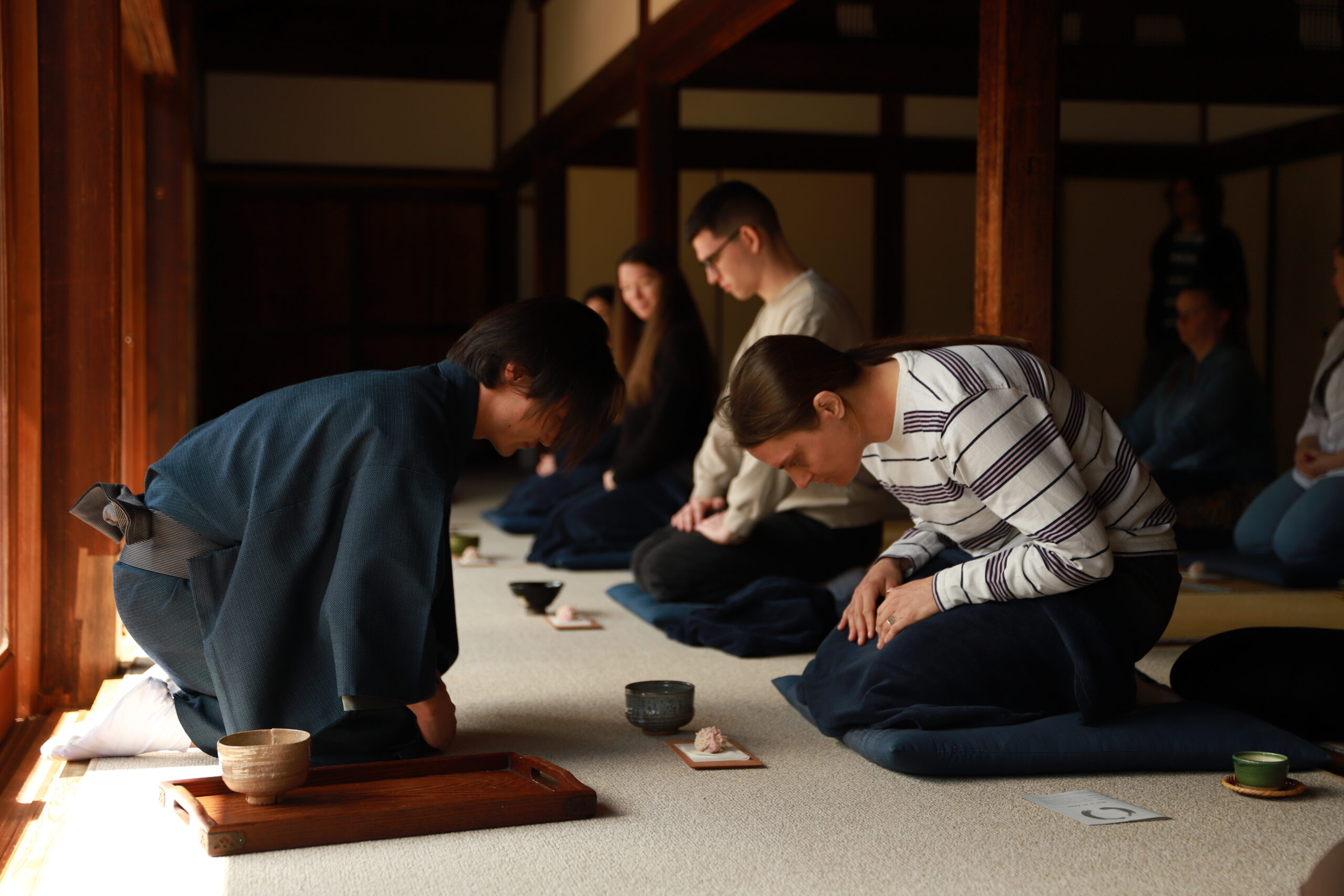
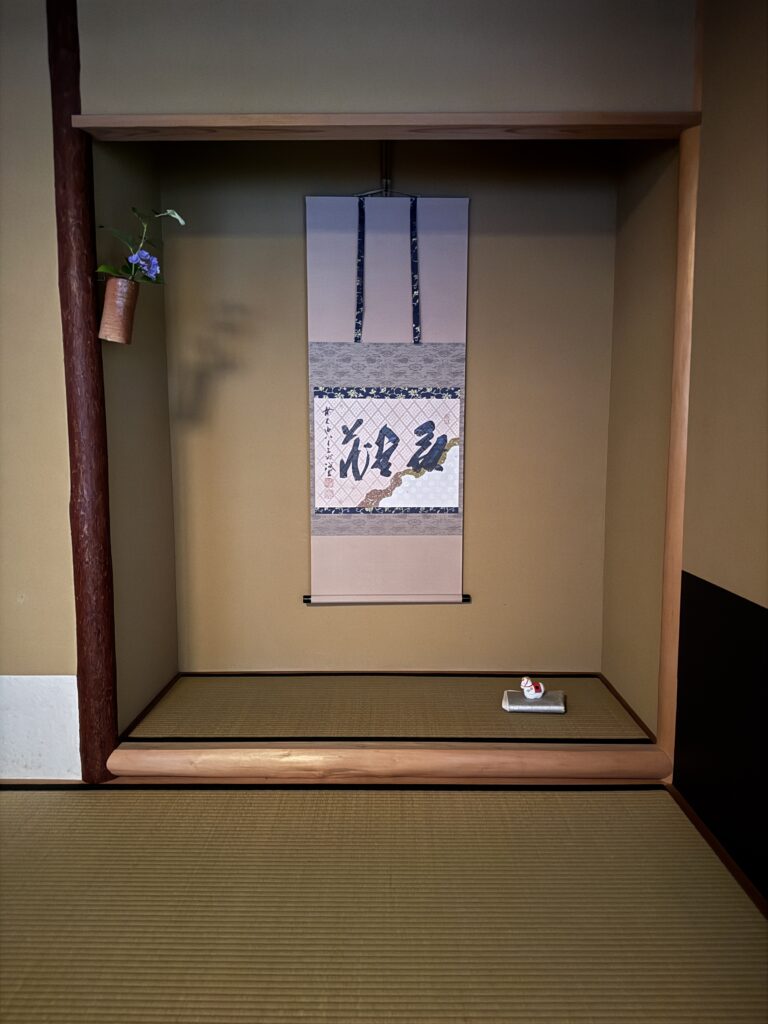
Once inside, I took a moment to admire the hanging scroll, the flowers, and the incense container displayed in the alcove. I was then served a traditional sweet.
I strongly felt a sense of “unity” that only a 4.5-mat room can create. I loved the atmosphere of this space.

A Tea Ceremony Kyoto Guests Rarely See: Dynamic Movements and the Perfect Bowl of Matcha
This was my first time watching the tea preparation procedure of the Yabuuchi school.
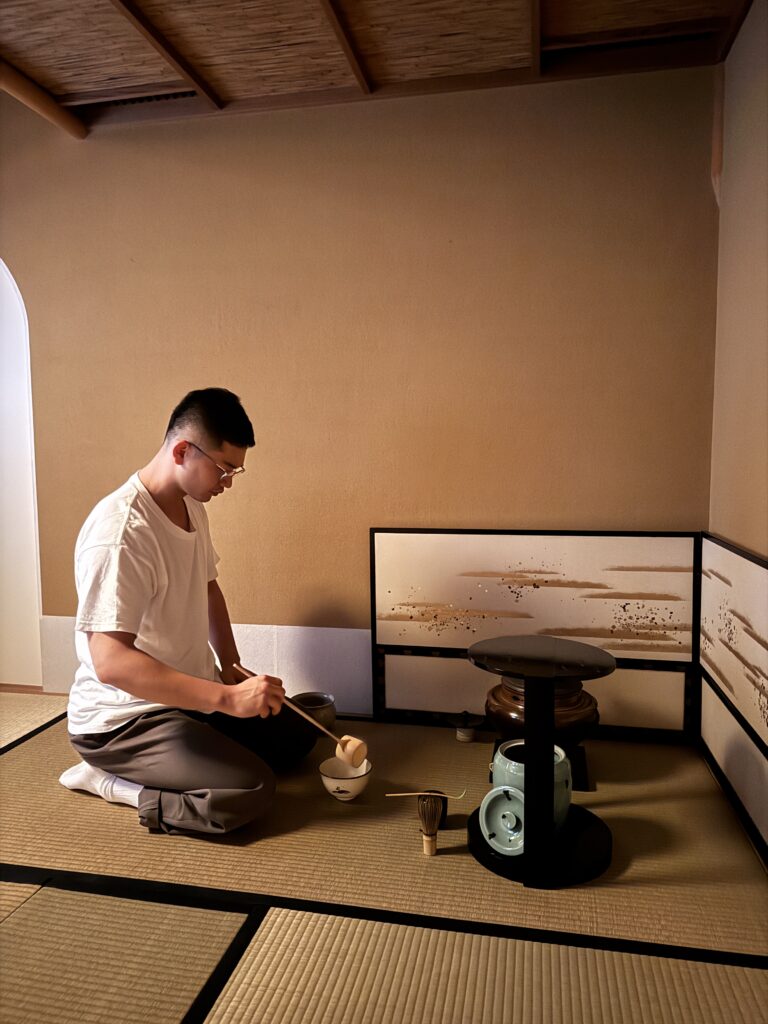
Ryotaro’s movements were dynamic. Now that I knew about the fukusa on the right hip and the broad, deliberate reach, I could see exactly what people mean by “samurai-style.” Watching him, it almost felt like there was a samurai sitting right in front of me. Personally, I liked this style and was completely drawn in.
While enjoying the sweetness of the wagashi (Kyoto confectionery as edible art) and his beautiful movements, the matcha was ready.

I took a sip.
The first thing that arrived was not the taste but the temperature — warm, not hot, so nothing got in the way. Then a gentle sweetness spread across the middle of my tongue, followed by a thick, almost broth-like umami that coated the whole mouth. The bitterness came last and stayed low, more like the finish of good dark chocolate than anything sharp. Nothing fought with anything else. After I finished, I found myself just looking at the bowl, mesmerized by the ring of bright green left inside it.
The matcha here is a different world from the sencha we serve as a welcome tea at our own zazen experience — that one is a rare Mandokoro-cha, and I wrote about visiting the farm here.
After finishing the tea, I was actually given the opportunity to whisk my own bowl of matcha.
In the dim light of the 4.5-mat room, I found myself concentrating much more deeply than in my daily life. My hand moved slower. I could hear the whisk against the bowl in a way I never notice at home. The sensation was completely different from how I usually feel when I whisk matcha. I truly felt the “power of the 4.5-mat tea room” firsthand.
There is a phrase the Yabuuchi school has used for centuries to describe what tea is supposed to teach: shōjiki, shōjō, reiwa, shitsuboku — honesty, purity, harmony, simplicity. As the school puts it: guard your heart with honesty, act with purity, meet others with harmony and courtesy, and cultivate yourself with simplicity.
Sitting in that small dark room with a bowl I had whisked badly, I understood the last one better than I had before.
A Beautiful Connection in Kyoto
Japan has diverse cultures, each with its own deep charm. This tea gathering made me realize there is still so much I have yet to learn, and made me want to explore even more. We at Denei will continue to experience and share these traditions with you!
[P.S. A Beautiful Kyoto Connection]
I found out that Miyashita Gofukuten actually makes the samue (traditional Japanese work clothes) for the president of Shioyoshiken, a highly prestigious traditional sweets shop in Kyoto.
Amazingly, Shioyoshiken is the exact same shop that makes the premium jonamagashi (fresh sweets) we serve to our guests during Denei’s experiences! Hearing this made me deeply feel the connections in the city of Kyoto.
Closing Thanks
To Ryotaro Miyashita — thank you for the invitation, for the tea ceremony Kyoto, and for letting me clumsily whisk a bowl of my own in your tea room. It was a genuinely wonderful morning.
And to four hundred years of the Yabuuchi family, and three generations of Miyashita: thank you for keeping these things alive long enough for someone like me to walk in and be surprised by them.
Want to experience Ryotaro’s tea ceremony?
Visiting Kyoto? We highly recommend his tea ceremony Kyoto experience!